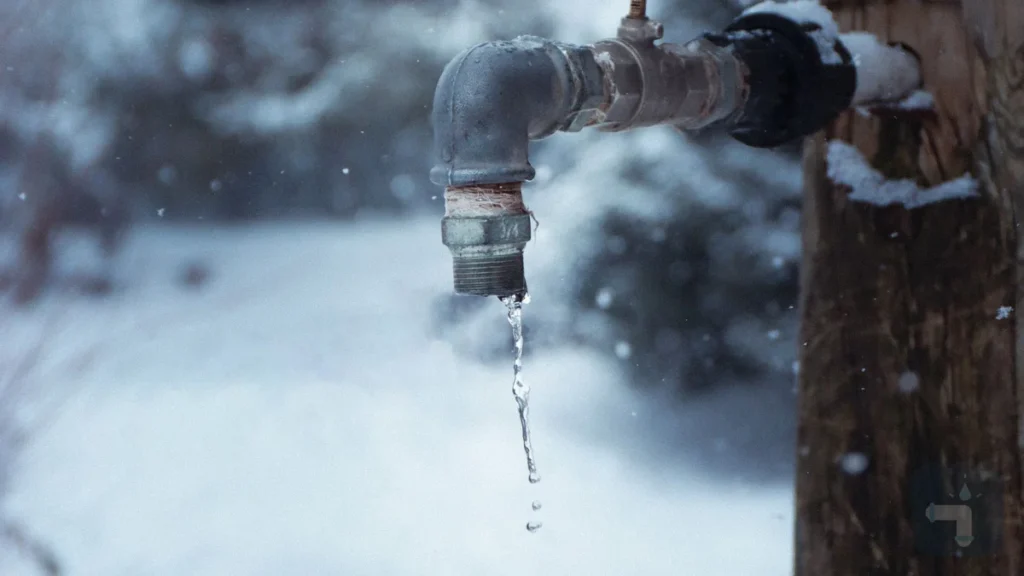
You turn on the garden hose for the first time in spring — and instead of a clean stream outside, water is running down inside your wall. That is the split hose bib: one of the most common, and most preventable, pipe bursts in Colorado. Here is what happened, how to confirm it, and what to do next.
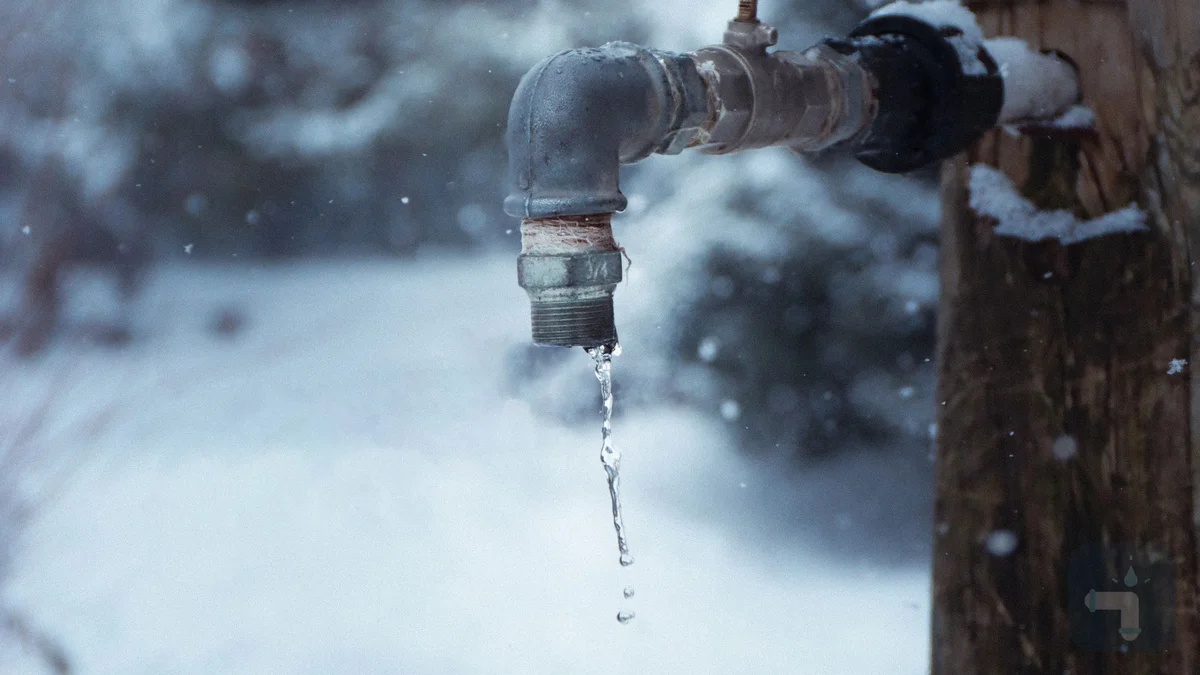
A standard outdoor faucet (hose bib, sillcock) on a Colorado home is usually a frost-proof design: the handle is outside, but the actual valve seat sits 8–14 inches back, inside the heated part of the wall, and the long tube between them is supposed to drain dry when the faucet closes. The design works — until a hose stays connected. A connected hose traps water in that tube. On the first hard freeze, the trapped water expands, and the thin copper tube splits lengthwise, typically inside the wall where nobody can see it.
The cruel part is the timing. All winter, the faucet’s valve holds pressure back, so the split section stays dry and invisible. The damage reveals itself on the first spring watering: full pressure fills the split tube, and most of the water goes into the wall, the rim joist, and down into the basement or crawl space — while the hose outside still runs, just weakly.
Close the outdoor faucet
That stops pressure to the split section immediately.
Close the indoor shutoff
Most hose bibs have a dedicated valve inside, near where the pipe exits. Close it and open the outdoor faucet to drain the tube.
Check below
Basement or crawl space under the faucet: look for water, and start drying anything wet.
Photograph it
If water got into the wall or basement, document before cleanup — the same routine as any water damage.
A split frost-proof sillcock is replaced, not patched — the tube is a single manufactured unit, and the split means its freeze protection is done. The good news: replacement is one of the more contained plumbing jobs there is, usually done from outside with some interior access — costs land in the small-repair band of the ranges in our Brighton cost guide, provided the wall and basement below did not soak up much water. The larger bill, as with most bursts, is never the pipe — it is how long the leak ran inside the wall before anyone noticed. A hose bib that “leaked a little” through a whole summer of watering can do more hidden damage than a dramatic January burst.
Prevention could not be simpler, and it is one line of our pre-winter checklist: every fall, disconnect every hose, drain the faucet, and fit a cover. Thirty seconds, once a year, is the entire price of never having this problem.
Brighton Burst Pipe is a referral service. If your test points to a split inside the wall, call (720) 918-0220 and we will connect you with an independent local provider who can replace the faucet and check the wall cavity for hidden water. The call costs nothing.
Most likely a split frost-proof sillcock. If a garden hose stayed connected over winter, trapped water froze and split the long tube inside the wall. The leak only shows when the faucet is used, because its valve holds pressure back the rest of the time.
Run the 60-second test: with the faucet on, listen and look in the basement or crawl space below it. Water sounds or dripping that start and stop with the faucet mean a split inside the wall. A drip only at the outdoor spout or handle usually means a washer or packing repair.
You should not. Every use pushes most of its water into the wall cavity — feeding mold and rot invisibly. Close its indoor shutoff valve until it is replaced; use a different faucet in the meantime.
It is one of the smaller plumbing jobs — the faucet unit plus contained labor — as long as water damage inside the wall or basement is limited. Extensive hidden soaking is what raises the total, which is why catching it on the first spring use matters.
Disconnect every garden hose in the fall, drain the faucet, close its indoor shutoff if it has one, and fit an insulated faucet cover. A frost-proof faucet only protects itself when it can drain — and it cannot drain through a connected hose.
The rim joist and wall cavity around the pipe, the basement ceiling below it, and any insulation that got wet. Wet insulation holds moisture against wood for weeks. If the area does not dry fully within a day or two, have it opened and checked rather than sealed up damp.
Call and we will connect you with an independent local provider in the Brighton area who can replace the faucet and check the wall for hidden water — the call itself costs nothing.
 Brighton Burst PipeBurst Pipe Repair · Brighton, CO