 Brighton Burst PipeBurst Pipe Repair · Brighton, CO

Burst Pipe Repair Cost in Brighton, CO
A burst pipe in a Brighton home usually leaves you with two bills, not one: the plumbing repair itself, and whatever the water did before you got it shut off. This page puts real numbers on both, using national cost data from Angi and HomeGuide, so you can walk into a provider’s quote knowing what the normal range looks like. One thing to know up front: Brighton Burst Pipe is a referral service, not a plumbing company. We do not do the work or set the prices. We connect you with an independent local provider, and you pay that provider. If water is running right now, skip the numbers and call (720) 918-0220 first — every section below will still be here when the floor is dry.
Call (720) 918-0220: get connected now
Short answer
How much does burst pipe repair cost in Brighton?
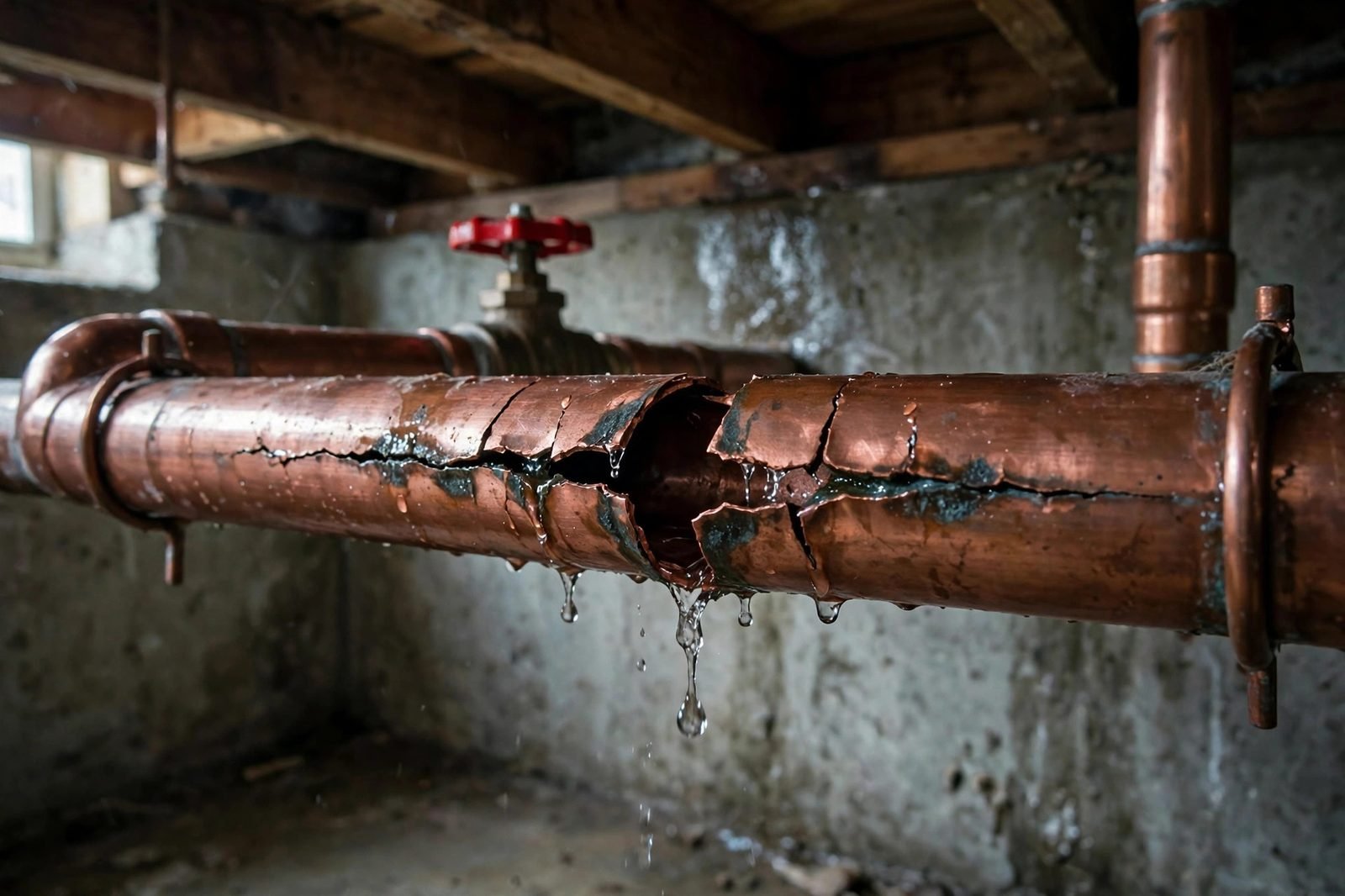
For the plumbing repair alone, most homeowners nationally pay $200 to $3,000, with an average around $500, according to Angi’s 2026 cost data. The work is usually priced by the foot: $150 to $250 per linear foot for materials and labor combined. From there, the total climbs with the emergency call-out, any repiping the burst points to, and the water damage cleanup afterwards. These are national figures — no cost guide publishes Brighton-specific pricing — but they are the same ranges local providers quote against, and they tell you whether a number you are handed is ordinary or an outlier.
| Job | Typical cost (national) | Source |
|---|---|---|
| Burst pipe repair, per linear foot (materials + labor) | $150 – $250 | Angi |
| Burst pipe repair, typical total (average ≈ $500) | $200 – $3,000 | Angi |
| Longer damaged section — 5 feet of pipe | $750 – $1,250 | Angi |
| Longer damaged section — 8 feet of pipe | $1,200 – $2,000 | Angi |
| Emergency call-out fee (nights, weekends, holidays) | $100 – $300 | Angi; HomeGuide lists a $150 – $250 surcharge for non-business hours |
| Emergency plumbing labor, per hour | $100 – $350 | HomeGuide |
| Repiping a whole house (average ≈ $7,500) | $1,500 – $15,000 | Angi |
| Repiping a 2,000 sq ft home — PEX | $2,000 – $4,000 | HomeGuide |
| Repiping a 2,000 sq ft home — copper | $8,000 – $16,000 | HomeGuide |
| Water damage cleanup & restoration, per sq ft of affected area | $3 – $7.50 | Angi |
| Water damage restoration, typical total (average ≈ $3,868) | $450 – $16,000 | Angi |
Sources: Angi, “How Much Does Burst Pipe Repair Cost?” (updated Oct 6, 2026); Angi, “How Much Does Water Damage Restoration Cost?” (updated Sep 11, 2026); HomeGuide, “How Much Does an Emergency Plumber Cost?” and HomeGuide whole-house repiping cost data. All figures are U.S. national data retrieved Nov 13, 2026. They are planning ranges, not quotes — your provider prices your actual pipe, your actual access, and your actual water damage.
What moves the price
What makes a Brighton burst pipe cheap or expensive?
The same four things that move the price anywhere move it in Brighton, plus one local factor: how much of the damage is freeze damage, because a frozen Brighton pipe rarely splits in just one tidy spot.
- Access. A burst in an open basement ceiling or crawlspace is the cheap version. The same split inside a finished wall, above a finished ceiling, or under a slab means demolition and drywall repair on top of the plumbing. Angi’s location ranges tell the story: a basement repair typically runs $200 to $600, a wall repair $150 to $500 before the drywall patch, and concrete-encased pipe can push far higher.
- How much pipe is damaged. One clean split is a short section at $150 to $250 a foot. A pipe that froze along a whole exterior-wall run — a common Brighton pattern in older homes near the Main Street historic district and the pre-1970 subdivisions — can mean replacing many feet, or being told honestly that the section is not worth saving.
- Pipe material and era. Brighton homes built or remodeled between 1978 and 1995 may still carry polybutylene, and 1950s–1970s homes often carry galvanized steel. Both change the conversation from “repair” to “how much of this system should go,” which is why our pipe replacement and repiping page exists. Newer Brighton subdivisions are mostly copper and PEX, which repair more predictably.
- Timing. A burst does not check the clock. Emergency labor runs $100 to $350 an hour (HomeGuide), plus a call-out fee of $100 to $300 for nights, weekends, and holidays (Angi). That premium is real, but a pipe pouring water into a finished basement costs more per hour than any plumber does.
- The water, not the pipe. Cleanup and restoration run $3 to $7.50 per square foot of affected area (Angi): about $3.50 for clean supply-line water, $5.25 for gray water, $7.50 for black water. Angi’s leak-repair data puts the cleanup added to a typical burst-pipe job at $1,000 to $2,000. This is the part of the bill your first 30 minutes controls.
Act fast
What should I do in the first 30 minutes after a pipe bursts?
The pipe repair price is mostly set by the pipe. The cleanup price is set by you, in the first half hour. A single burst pipe can release hundreds of gallons an hour, and mold can begin on wet drywall and wood within 24 to 48 hours. Here is the order that keeps a Brighton burst from becoming a Brighton restoration project:
- Minutes 0–5: shut off the main water valve. In Brighton homes the main shutoff is usually on the street-facing side — basement, crawlspace, utility room, or garage, near where the water line comes through the foundation. A round wheel closes clockwise; a lever is off when it sits across the pipe. No indoor valve? The backup is the curb stop at the property line, a round lid in the ground, often stamped “WATER.”
- Minutes 5–10: make it electrically safe, then drain the lines. If water is near outlets, appliances, or the breaker panel, switch off the breaker for that area — and never step into standing water to reach the panel. Then open cold faucets, then hot, to drain what is left in the pipes and take pressure off the break.
- Minutes 10–20: photograph everything. The burst area, the water trail, every damaged surface, before anything moves. Insurers separate “sudden and accidental” damage, which standard policies usually cover, from gradual leaks, which they usually do not. Your photos are the proof of which one this was.
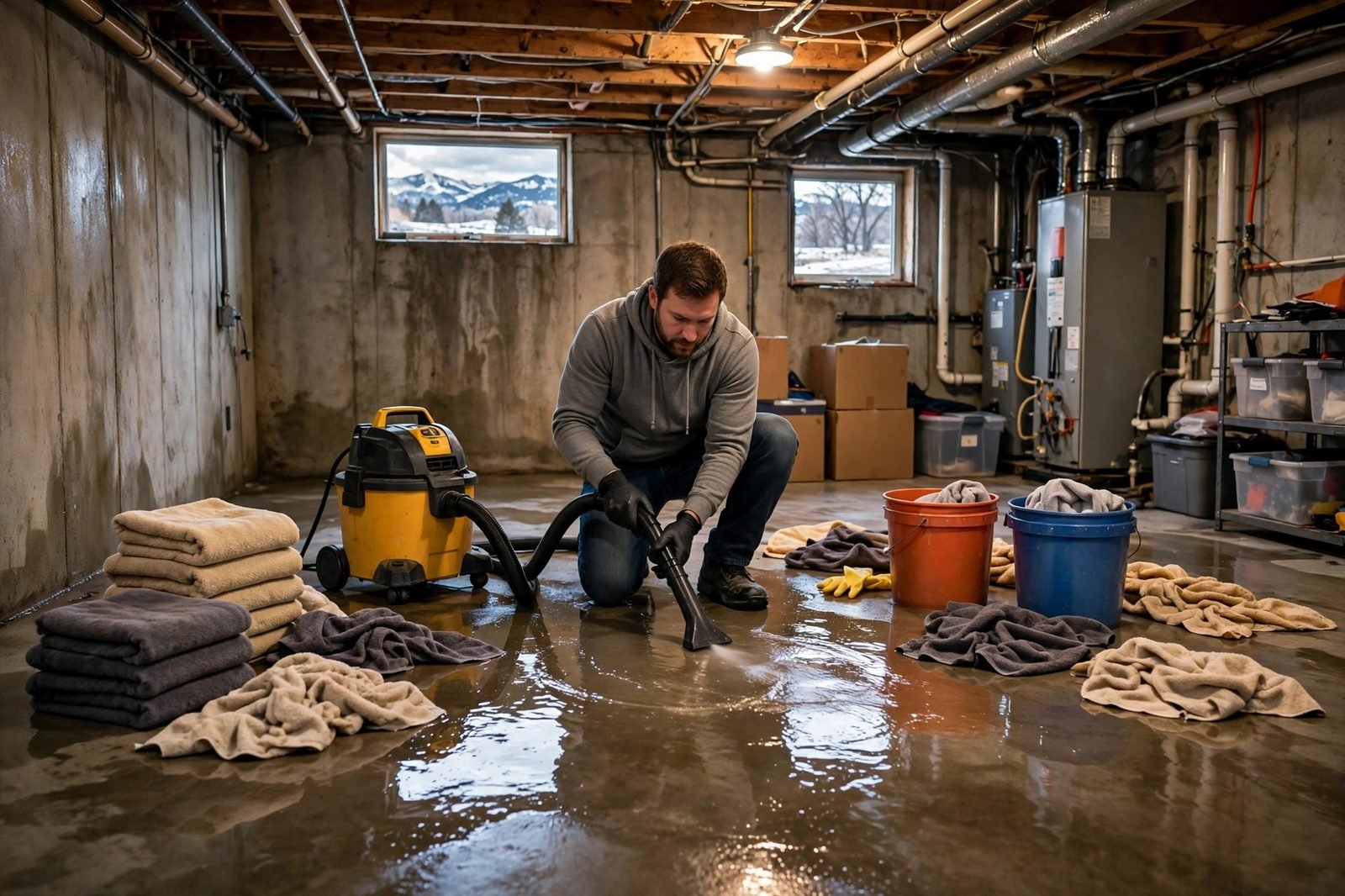
- Minutes 20–30: start water removal and call. Towels, a wet vacuum, buckets, furniture up on blocks or out of the room. Then call (720) 918-0220. Tell us where the water is, whether the main valve is off, and whether water is near anything electrical, and we connect you with an independent local provider. Drying that starts the same day as the pipe fix is what keeps cleanup near the low end of the ranges above — our water damage cleanup page walks through what that involves.
Prevent the next one
How do I keep my Brighton pipes from freezing?
Brighton sits at about 5,000 feet on the Front Range, and its winters do not ease in. January overnight lows average around 23°F, and arctic snaps can hold the area below freezing for days — the December 2022 blast brought wind chills near 35 below zero to the Front Range. The working rule from pipe-freeze research used in American Red Cross guidance: once outdoor temperatures reach about 20°F or below, exposed and uninsulated pipes are in genuine danger, especially in unheated spaces. Prevention is mostly a short list of cheap steps done before that night arrives:
- Insulate the pipes you can reach. Foam pipe sleeves on every exposed run in the basement, crawlspace, garage, and attic. Hose bibs, pipes in exterior walls, and lines through unheated spaces freeze first — if you insulate nothing else, insulate those.
- Disconnect hoses and drain hose bibs before the first hard freeze, which in the Brighton area typically arrives around early October. A hose left attached traps water in exactly the fitting most likely to split. Our frozen pipe thawing and repair page covers what to do when one freezes anyway.
- Seal the gaps. Caulk and weatherstripping where pipes pass through exterior walls, and close crawlspace and basement vents against winter air. Wind-driven cold through one rim-joist gap can freeze a pipe that insulation alone would have saved.
- On the coldest nights, drip and open. Let faucets served by vulnerable pipes — especially on exterior walls — drip slightly; moving water resists freezing, and an open faucet relieves the pressure buildup that actually splits pipes. Open the cabinet doors under sinks on exterior walls so warm room air reaches the plumbing.
- Hold the heat. Keep the thermostat at 55°F or higher when you are away in winter, and skip the deep nighttime setback during a hard snap. A slightly higher heating bill in a Brighton cold week is nothing next to a $3,868 average restoration bill. If you are traveling, the safest version is the main valve off and the lines drained before you leave.
- Know your pipe material before winter, not after. If your home was built or remodeled between 1978 and 1995, find out whether it has polybutylene; if it is 1950s–1970s stock, check for galvanized steel. Many insurers now ask about pipe material, and some will not write policies on polybutylene homes. A provider can identify what is in your walls in minutes from any exposed section.

Decide
Should I repair the section or repipe?
One split in an otherwise sound system is a section repair: a few feet at $150 to $250 a foot, done in hours. Repiping is the answer when the system itself is the problem — polybutylene throughout a 1980s Brighton home, galvanized steel narrowed by decades of corrosion, or the third leak this year. Nationally, a whole-house repipe runs $1,500 to $15,000 with an average around $7,500 (Angi); for a typical 2,000 sq ft home, HomeGuide puts PEX at $2,000 to $4,000 and copper at $8,000 to $16,000. Ask the provider to quote both paths when the pattern suggests it, and ask what they found that justifies the bigger number. Our pipe replacement and repiping page explains how providers evaluate it.
Answers
Burst pipe cost questions, answered
How much does it cost to fix one burst pipe in Brighton, CO?
Nationally, most burst pipe repairs land between $200 and $3,000, with an average around $500 (Angi). The work is typically billed at $150 to $250 per linear foot for materials and labor, so a single short split in an accessible spot sits near the low end, and a long or hard-to-reach section climbs from there. Your provider quotes your actual job after seeing it — be wary of any firm number given before that.
Why did my quote come in higher than these ranges?
Usually access or water damage, not the pipe. A repair inside a finished wall adds demolition and drywall work; a basement pipe encased in concrete adds more. And if water spread, the cleanup — $3 to $7.50 per square foot — is a separate line from the plumbing. Ask the provider to break the quote into pipe repair, access and restoration, and cleanup, so you can see which part is driving the total.
How much is the emergency call-out on top of the repair?
Angi puts emergency call fees at $100 to $300 on top of the base rate, and HomeGuide lists a $150 to $250 service call fee or surcharge for non-business hours, with emergency labor at $100 to $350 an hour. Nights, weekends, and holidays cost the most. Ask for the call-out fee on the phone before anyone drives out — a straight answer is a good sign.
How much does water damage cleanup add after a burst?
Angi’s restoration data averages about $3,868 per job, ranging from $450 for small, fast-contained incidents to $16,000 for severe ones, priced at roughly $3.50 per square foot for clean water, $5.25 for gray water, and $7.50 for black water. How fast you shut the water off and start drying is the biggest factor you control — see the first-30-minutes steps above.
Does homeowners insurance cover burst pipe repair in Brighton?
Standard policies usually cover the water damage from a “sudden and accidental” burst, and frozen-pipe bursts are the textbook example. What they usually exclude is gradual damage — the slow leak that ran for months — and the pipe repair itself is often treated separately from the damage it caused. Photograph everything before cleanup, keep the split pipe section until the adjuster has seen it or released it, and report the claim promptly.
At what temperature do pipes actually freeze in Brighton?
Water freezes at 32°F, but your pipes feel the temperature where they sit, not the thermostat reading. Research behind the American Red Cross guidance puts the danger point at outdoor temperatures around 20°F or below for exposed or uninsulated pipes — and Brighton passes that mark regularly in January, with overnight lows averaging about 23°F and cold snaps running far lower. A pipe in an unheated crawlspace can freeze while the house above it feels perfectly warm.
Is it cheaper to wait until morning than to call at night?
The call itself is cheaper in daylight — no call-out premium. But if water is still flowing, or has spread into finished space, waiting trades a $100 to $300 fee for hours of extra water damage at $3 to $7.50 a square foot. If you have the main valve fully off, the area safe, and drying started, waiting for a morning call is reasonable. If you cannot stop the water, call now.
Who do I call about a burst pipe in Brighton, CO?
Call (720) 918-0220. You will reach Brighton Burst Pipe, a referral service — not a plumbing company. We take your address and a quick description, then connect you with an independent local provider who takes burst pipe calls in the Brighton area. The call costs you nothing; you pay the provider for the work, after they quote it.
Water where it should not be?
Shut off your main valve, then call. We will connect you with an independent local provider who handles burst pipe emergencies in the Brighton area. The call itself costs nothing.
Brighton Burst Pipe connects callers in Brighton and nearby Adams & Weld County communities with local independent plumbing providers. We are a referral service and do not perform plumbing work.