 Brighton Burst PipeBurst Pipe Repair · Brighton, CO

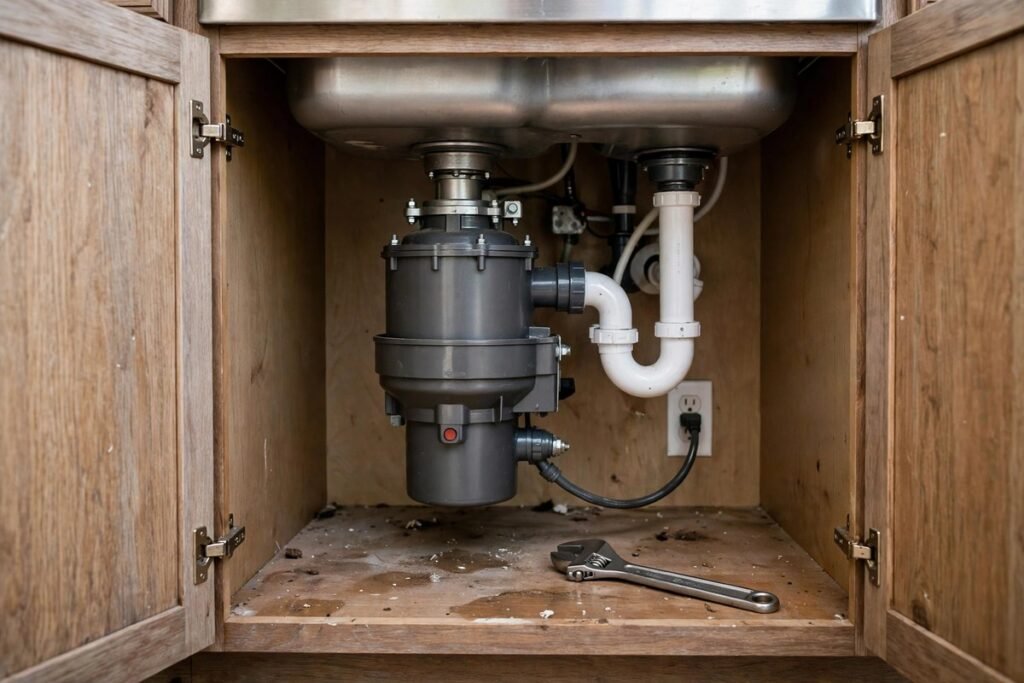
A garbage disposal usually tells you what is wrong by the sound it makes — or by the silence. A hum with no grinding means it is jammed. A leak under the sink means a seal or a connection has failed. Silence, with no hum at all, usually means it has no power, or it has tripped its own reset. This guide explains what each symptom means, the safe checks you can do yourself, and when a disposal should be repaired and when it should be replaced.
One safety rule comes first, and it applies to every disposal job: never put your hand inside a garbage disposal, even when it is switched off. Use tongs, pliers, or the hex key that came with the unit, and turn the power off at the switch — and at the breaker if you are working underneath it — before you reach under the sink. Brighton Burst Pipe is a referral service, not a plumbing company: when you call (720) 918-0220, we connect you with an independent local provider who can diagnose the fault and quote for the repair or replacement.
Why is your garbage disposal humming but not grinding?
A hum with no grinding means the motor is getting power, but the grinding plate cannot turn — it is jammed. Something is stuck between the plate and the wall of the unit: a piece of bone, a bottle cap, a piece of cutlery, or a build-up of fibrous food such as celery, artichoke, or onion skins. The motor hums because it is trying to turn, and if you leave it humming, the motor can overheat and trip its own thermal protection, or burn out altogether.
Turn it off at once. Do not keep running a humming disposal, and do not press the reset button again and again while it is still jammed. Turn the power off at the switch, then look inside with a torch — never your hand — and remove anything you can see with tongs or pliers. Then, with the power still off, use the hex key in the socket at the bottom of the unit to work the plate back and forth until it turns freely. Once it turns, turn the power back on, run cold water, and press the reset button. If it still hums, or if the plate will not turn, the jam may be deeper, or the motor may have failed — and a provider should look at it.
Why is your garbage disposal leaking?
A leak under the sink is usually one of three things, and finding which one it is tells you whether it can be repaired. Dry the area, run water through the disposal, and watch where the water appears.
- From the top, where the disposal meets the sink. The mounting flange or the seal between the disposal and the sink has failed, or the mounting bolts have loosened. Tightening the bolts or replacing the seal can fix it.
- From a drain connection. The dishwasher inlet, the drain pipe, or the trap connection can leak at a joint, especially if a hose clamp has loosened or a gasket has worn. Tightening or replacing the connection is usually a straightforward repair.
- From the body of the disposal itself. Water coming from a crack in the housing, or from the bottom of the unit, usually means the disposal has rusted through or cracked from the inside. A leaking body cannot be repaired reliably — the disposal needs to be replaced.
Brighton hard water, at 15–20 grains per gallon, can leave scale inside a disposal and on its seals, and a disposal that has been in place for many years will corrode from the inside. If the leak is from the body, do not keep using the disposal — turn the power off, put a bucket underneath, and call a provider. Water leaking under a sink can damage the cabinet, the floor, and the wall behind it, and water damage clean-up is listed on this site at $3–$7.50 per square foot.
Why is your garbage disposal completely dead?
Silence, with no hum at all, usually means the disposal has no power, or it has tripped. Check the simple things first: is the switch on, has the breaker tripped, and is the disposal plugged in under the sink? Some disposals are plugged into a socket under the sink, and the plug can work loose. Press the reset button on the bottom of the unit — a small red or black button — and try again. If the reset button pops out again at once, or the disposal trips the breaker, there is a deeper fault, and the unit should not be used until a provider has looked at it.
If the disposal has power and still does nothing, the motor may have failed, or the internal wiring may be damaged. Do not open the disposal or work on its wiring yourself. A provider can test the motor and the supply, and tell you whether a repair is sensible or whether the unit should be replaced. Age helps you decide: a disposal that has been in place for many years, that has leaked, or that has needed repeated repairs is usually better replaced than repaired again.
Should you repair or replace your garbage disposal?
Repair is usually the right choice when the disposal is jammed, when a seal or a connection is leaking, or when the reset button has tripped and the unit works again once it is cleared. Those are simple faults, and a provider can fix them in one visit. Replacement is usually the right choice when the body of the unit is leaking, when the motor has failed, or when the disposal is old and has needed repeated repairs.
- Repair it when: it hums because it is jammed, it leaks from a connection or a seal, or it has tripped its reset and works again once cleared.
- Replace it when: water comes from the body of the unit, the motor has failed, it trips the breaker again and again, or it is old and has needed repeated repairs.
- Ask for both quotes if you are not sure — a repair quote and a replacement quote side by side, with the reasoning, not just a price.
What should never go down a garbage disposal?
Many disposal problems are caused by what goes into them. A disposal is designed for small amounts of soft food waste, with cold water running — not for everything from the kitchen. Grease is a particular problem: it goes down hot and liquid, then cools and hardens in the drain, catching food and debris, and it can block the drain further down the pipe as well as the disposal itself.
- Never put grease or oil down the disposal. Wipe it from pans and put it in the bin.
- Never put fibrous foods down it — celery, artichoke, corn husks, onion skins, and asparagus can wrap around the grinding plate and jam it.
- Never put bones, fruit pits, or shells down it — they can jam the plate or damage the unit.
- Never put coffee grounds, pasta, rice, or potato peelings down it in quantity — they swell or clump and can block the drain.
- Never put non-food items down it — bottle caps, cutlery, glass, or plastic will jam or damage the unit.
- Always run cold water before, during, and after using the disposal, to flush food through the drain.
How much does a garbage disposal repair cost?
The site publishes no figure for a garbage disposal repair or replacement, so this guide does not invent one. The cost drivers are the fault — a jam, a seal, or a failed motor — the part needed, whether the unit needs to be removed, and the labour. Labour on this site is listed at $100–$350 per hour, and an emergency call-out at $100–$300. A jammed disposal that a provider clears in one visit is a different job from a disposal that needs to be removed and replaced, and only a provider who has seen the unit can give you a final price. Ask for the diagnosis, the part, and the labour to be listed separately.
A running disposal is rarely an emergency, and a scheduled visit is usually cheaper than an emergency call. If water is leaking under the sink, turn the power off, put a bucket underneath, and call for help — a leak that is left alone can damage the cabinet and the floor, and water damage clean-up is listed on this site at $3–$7.50 per square foot.
Frequently Asked Questions
Why is my garbage disposal humming?
Because it is jammed. The motor is getting power but the grinding plate cannot turn. Turn it off at once, remove anything you can see with tongs, and work the plate free with the hex key — never your hand. If it still hums, call a provider.
Why is my garbage disposal leaking?
Usually a failed seal or a loose connection at the top or at a drain joint, which can often be repaired — or a crack in the body of the unit, which cannot be repaired reliably and needs replacement. Dry the area and watch where the water appears.
How do I reset my garbage disposal?
Press the reset button on the bottom of the unit, a small red or black button, after you have cleared any jam and turned the power off and on again. If it pops out again at once, or it trips the breaker, do not keep resetting it — call a provider.
Can I put my hand in a garbage disposal?
No, never — even when it is switched off. Use tongs, pliers, or the hex key, and turn the power off at the switch and at the breaker before you work underneath the sink.
Should I repair or replace a leaking disposal?
It depends on where the leak is. A leak from a seal or a connection can usually be repaired. A leak from the body of the unit usually means the disposal has rusted through and needs to be replaced.
What should never go down a garbage disposal?
Grease, fibrous foods, bones, fruit pits, coffee grounds in quantity, pasta and rice, and any non-food items. A disposal is designed for small amounts of soft food waste, with cold water running.
Garbage disposal not working in Brighton?
If your disposal hums, leaks, or will not start at all, do not keep running it and hope it clears — a jammed motor can burn out, and a leak can damage the cabinet and floor. Call (720) 918-0220 and we will connect you with an independent local provider in the Brighton area who can diagnose the fault, explain whether a repair or a replacement is the better choice, and quote for the work. Tell them whether it hums, leaks, or is completely dead, and what you have tried already — that helps them bring the right part and give you a clear price.