 Brighton Burst PipeBurst Pipe Repair · Brighton, CO
A slow drain is easy to ignore until the morning the shower will not empty, the kitchen sink backs up, or the toilet gurgles when the washing machine runs. By then, a small blockage has usually become a bigger one. Knowing what drain cleaning should cost in Brighton — and what changes the price — helps you decide whether to try a simple fix, book a standard visit, or ask for a camera inspection before anyone starts work.
This guide covers drain cleaning costs in Brighton, CO, using only the figures published on this site. It explains the difference between snaking, camera inspection, and hydro jetting, why a main drain costs more than a single sink, and the Brighton factors — hard water, tree roots, and older clay and cast-iron pipes — that turn a simple job into a larger one. Brighton Burst Pipe is a referral service, not a plumbing company: when you call (720) 918-0220, we connect you with an independent local provider who can attend, diagnose the blockage, and quote for the work.
How much does drain cleaning cost in Brighton, CO?
The short answer is that a single fixture snaking in Brighton typically costs $100–$275 nationally, according to the figures published on this site. A main sewer drain cleaning typically costs $250–$500, a camera inspection $100–$350, and hydro jetting $350–$800. Those are national ranges, not a quote for your home, but they give you a fair starting point — and a way to spot a quote that is far outside what the work should cost.
| Job | Typical range published on this site |
| Single fixture snaking | $100–$275 nationally |
| Main sewer drain cleaning | $250–$500 nationally |
| Camera inspection | $100–$350 nationally |
| Hydro jetting | $350–$800 nationally |
| Emergency call-out | $100–$300 |
| Labour | $100–$350 per hour |
Only a provider who has seen the drain can give you a final price. A kitchen sink blocked with grease is a different job from a main drain blocked with tree roots, and a drain that has been snaked three times in a year is telling you something different from a drain that has blocked once. Ask for the method, the diagnosis, and the price to be explained before work starts — snaking, jetting, and camera inspection are not interchangeable, and you should know which one you are paying for.
What affects the price of drain cleaning?
Location is the first thing that matters. A blockage in a single sink, bath, or shower is usually near the fixture and easy to reach. A blockage in the main drain, or in the sewer line outside the house, is further from the fixture, harder to reach, and more likely to need a camera or a jetter. That is why the main drain range on this site, $250–$500, sits above the single fixture range of $100–$275.
- Which drain is blocked. One slow fixture usually points to a local blockage. Several slow fixtures, gurgling, or sewage coming up in the lowest drain usually point to the main drain or the sewer line.
- What is blocking it. Hair and soap in a shower, grease in a kitchen sink, and wipes or sanitary products in a toilet are common causes. Tree roots, a collapsed pipe, or a pipe full of scale need more than a snake.
- How the pipe is reached. A cleanout in the garden or basement makes the job quicker. No cleanout, a blocked access point, or a drain under a driveway or patio makes it slower — and labour on this site is listed at $100–$350 per hour.
- Whether a camera is needed. A camera inspection, listed at $100–$350, shows exactly where the blockage is and what is causing it. It is worth the cost when a drain keeps blocking, when several fixtures are affected, or when a provider suspects roots or a damaged pipe.
- Whether jetting is needed. Hydro jetting, listed at $350–$800, uses high-pressure water to clear grease, scale, and roots from the inside of the pipe. It costs more than snaking, but it cleans the pipe rather than just punching a hole through the blockage.
- When you call. An emergency call-out is listed on this site at $100–$300. A drain that is backing up sewage into the house cannot wait; a slow sink that still drains can usually wait for a scheduled visit.
Brighton homes add two local factors. First, hard water leaves scale inside pipes, which narrows them over time and gives grease and debris something to catch on. Second, many older Brighton homes still have clay or cast-iron sewer lines, which are more vulnerable to tree roots and to cracking than modern PVC. If your house was built in the 1960s or 1970s, or you have large trees near the sewer line, tell the provider — it changes what they bring and what they look for.
Is snaking, camera inspection, or hydro jetting right for your drain?
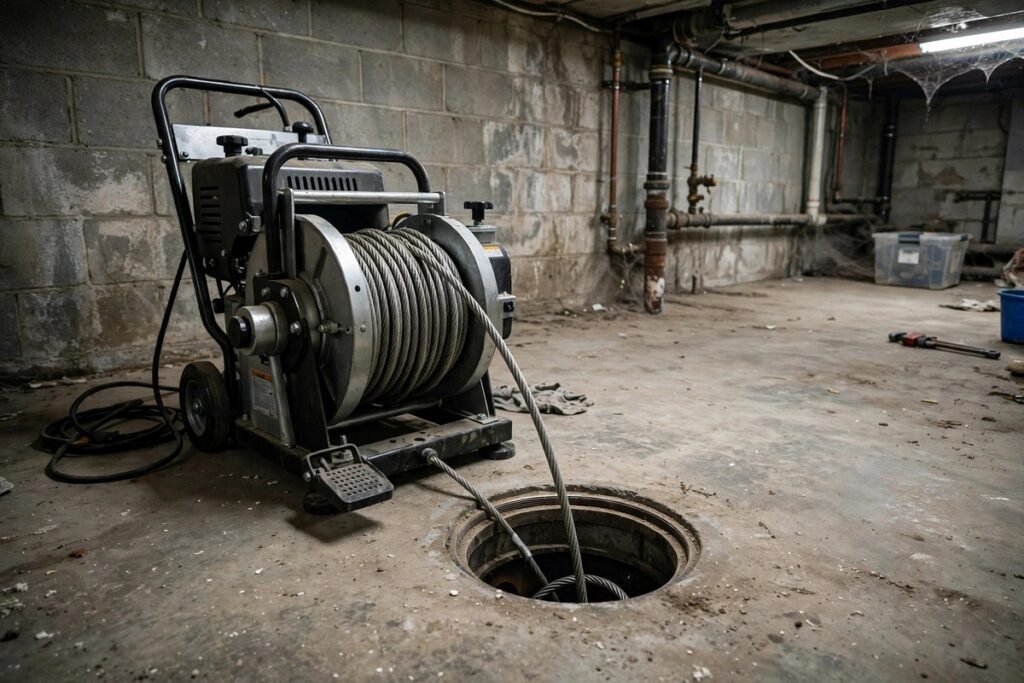
Snaking is the usual first step. A flexible cable with a cutting head is fed into the drain to break up or pull out the blockage. It is quick, it works well on hair, grease, and soft blockages, and for a single fixture it is usually the cheapest option, at $100–$275 nationally. But snaking does not clean the pipe walls, and it does not show you what caused the blockage. If the same drain blocks again within weeks, snaking alone has not solved the problem.
A camera inspection is the next step when the cause is not clear. A small camera on a flexible cable is fed into the drain, and the provider can see the inside of the pipe on a screen — roots, cracks, a collapsed section, a belly where water sits, or a pipe full of scale. At $100–$350, it can save money in the long run by stopping you from paying for repeated snaking on a pipe that needs repair. Ask to see the footage, and ask for the distance and depth of any problem found, so you have a record if repair work is quoted later.
Hydro jetting is the thorough option. High-pressure water scours the inside of the pipe, removing grease, scale, and roots. At $350–$800, it costs more than snaking, but for a main drain that keeps blocking, or a kitchen line coated in grease, it can restore the pipe to near its full width. Jetting is not suitable for every pipe — a provider should check the condition of the pipe first, because high-pressure water in a cracked or collapsed pipe can make things worse.
What can you safely try before calling a provider?
Some simple checks are safe and can save a call-out. Remove the plug or strainer and clear hair and debris by hand. Check whether the trap under the sink is blocked — put a bucket underneath, unscrew it carefully, and clear it out. Run hot water for a minute and see whether the drain clears. Check whether only one fixture is affected, or whether several are slow at the same time, and check the lowest drain in the house, which is usually the first to show a main drain problem.
- Do try: clearing strainers and traps, removing visible hair and debris, and noting which fixtures are affected.
- Do not keep plunging a toilet that is overflowing — stop, turn off the water to the toilet if you can, and call for help.
- Do not pour chemical drain cleaners into a drain again and again. They rarely clear a serious blockage, they can damage pipes and seals, and they make the drain unsafe for the provider who has to work on it afterwards. Tell the provider if you have used one.
- Do not use a drain snake yourself on a main drain if you have not done it before — a cable can get stuck, damage a pipe, or push the blockage further in.
If water is coming up through a drain, a shower, or a toilet, stop using water in the house — no showers, no washing machine, no dishwasher — and call for help. Sewage in the home is a health risk, and the clean-up that follows a backup is listed on this site at $3–$7.50 per square foot for water damage clean-up, so stopping the water early matters. If the backup is in the lowest drain only, and other fixtures are fine, it may still be a main drain problem — do not assume it will clear on its own.
How can you stop drains from blocking again?
Most repeat blockages are caused by what goes down the drain, not by bad luck. Grease is the biggest culprit in kitchens: it goes down hot and liquid, then cools and hardens inside the pipe, catching food and debris. Wipe grease from pans with a paper towel and put it in the bin, and use a strainer in the sink. In bathrooms, hair catchers in showers and baths stop the most common cause of slow drains before it starts.
- Never flush wipes, even ones labelled flushable. They do not break down like toilet paper, and they are a leading cause of toilet and main drain blockages in Brighton homes.
- Keep sanitary products, cotton buds, and nappies out of the toilet. Only toilet paper and human waste should be flushed.
- Run hot water after washing greasy dishes, and clean sink strainers regularly.
- Watch for tree roots. If you have large trees near the sewer line and the drain blocks repeatedly, ask for a camera inspection — roots grow back after snaking, and only a camera shows how bad the problem is.
- Have the main drain cleaned before it blocks. For a home with a history of blockages, a scheduled clean is cheaper and cleaner than an emergency call when sewage is already backing up.
Brighton hard water also plays a part. Scale narrows pipes over time, so a drain that was fine ten years ago may now block more often. A provider who finds heavy scale may suggest jetting to restore the pipe, or a water softener to slow further build-up. Neither is a quick fix, but both address the cause rather than the symptom.
What should a drain cleaning visit include?
A good visit starts with questions: which fixtures are affected, when it started, whether it has happened before, and what has been tried already. The provider should then check the affected drains, find the blockage, clear it by the right method, and test the drain by running water through it. If a camera was used, they should show you what it found and explain what it means.
- A clear diagnosis — where the blockage is, and what caused it.
- The method explained — snaking, camera, or jetting, and why that method was chosen.
- A written quote — method, labour, and any call-out or camera charge, listed separately.
- A test after clearing — water run through the drain to confirm it is flowing freely.
- Advice on prevention — what to keep out of the drain, and whether a follow-up inspection is needed.
Ask what happens if the blockage comes back within a few weeks. Some providers will return to re-check a drain they have just cleared; others will charge again. Ask before the work starts, not after it fails. And if the provider finds roots, a crack, or a collapsed section, ask for the camera footage and a written description — you will need both if repair or replacement is quoted later. A spot repair on a sewer line is listed on this site at $1,000–$4,000, and a full replacement at $3,000–$25,000, so a camera inspection that finds the problem early is money well spent.
Frequently Asked Questions
How much does drain cleaning cost in Brighton, CO?
A single fixture snaking typically costs $100–$275 nationally, a main sewer drain cleaning $250–$500, a camera inspection $100–$350, and hydro jetting $350–$800, according to the figures published on this site. The final price depends on which drain is blocked, what is blocking it, and how it is reached.
Why does my drain keep blocking?
Repeat blockages usually mean the cause has not been removed — grease and scale coating the pipe, tree roots growing back after snaking, or a damaged or narrowed section of pipe. A camera inspection shows the cause, and jetting or repair may be needed instead of another round of snaking.
Is hydro jetting better than snaking?
Jetting cleans the inside of the pipe, while snaking usually just clears a path through the blockage. Jetting costs more — $350–$800 against $100–$275 for a single fixture snaking — but for a main drain that keeps blocking, or a line coated in grease or scale, it can be the better choice. A provider should check the pipe condition first, as jetting is not suitable for a cracked or collapsed pipe.
Are chemical drain cleaners safe?
They rarely clear a serious blockage, they can damage pipes and seals, and they make the drain unsafe for the provider who works on it afterwards. Clearing strainers and traps by hand is safer, and if that does not work, a provider can clear the drain properly.
What should I do if sewage is backing up into my home?
Stop using water, keep people and pets away from the sewage, and call for help straight away. Do not keep flushing or running taps. Sewage is a health risk, and the longer it runs, the more clean-up is needed.
Does an emergency drain call cost more?
An emergency call-out is listed on this site at $100–$300. A slow sink that still drains can usually wait for a scheduled visit; a drain that is backing up sewage cannot.
Need a drain cleaned in Brighton?
If a drain is slow, gurgling, or backing up, do not wait for it to clear on its own — it rarely does, and a backup is far messier than a scheduled clean. Call (720) 918-0220 and we will connect you with an independent local provider in the Brighton area who can find the blockage, explain whether snaking, a camera, or jetting is needed, and quote for the work. Tell them which fixtures are affected and whether it has happened before — that helps them bring the right equipment and give you a clear price.