 Brighton Burst PipeBurst Pipe Repair · Brighton, CO

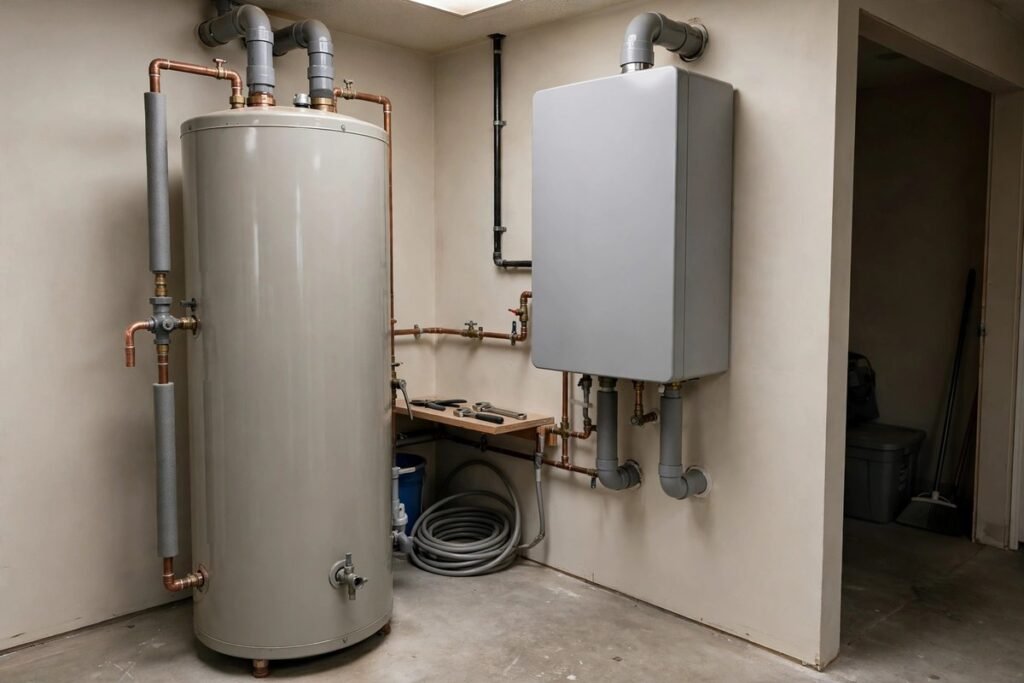
When a water heater fails in Brighton, the question is rarely just whether to replace it — it is what to replace it with. A standard tank heater is the familiar choice: a big insulated cylinder that keeps 40 or 50 gallons of water hot all day. A tankless heater is the newer one: a compact unit on the wall that heats water only when a tap is turned on. Both can work well in a Brighton home, but they suit different households, different houses, and different budgets.
This guide compares tank and tankless water heaters for Brighton, CO, using only the figures published on this site. It explains how each type works, what each one costs, how Brighton hard water affects them, and how to choose for your household. Brighton Burst Pipe is a referral service, not a plumbing company: when you call (720) 918-0220, we connect you with an independent local provider who can look at your home, explain your options, and quote for the installation.
How does a tank water heater work?
A tank heater stores hot water and keeps it hot. A gas burner or an electric element heats the water in the tank, a thermostat keeps it at the set temperature, and when you turn on a tap, hot water flows out and cold water flows in to replace it. The tank is always working, even at night, to keep that stored water hot — which is why it is called a storage heater.
The size of the tank decides how much hot water you have at once. A standard tank in Brighton is usually 40 or 50 gallons. A 40-gallon tank that was fine for two people may struggle for a family of five, especially if showers, laundry, and dishes all happen at the same time. When the tank runs out, you wait for it to reheat — which is the most common complaint about tank heaters, and the reason some households consider tankless.
How does a tankless water heater work?
A tankless heater has no tank. When you turn on a hot tap, cold water flows through a heat exchanger, a gas burner or an electric element heats it in seconds, and hot water flows out. When you turn the tap off, the heater stops. There is no stored water to keep hot, no tank to run out of, and no tank to leak — but there is a limit to how much hot water the unit can heat at once, which is called its flow rate.
That flow rate matters in Brighton winters, when the incoming cold water is very cold and the heater has to work harder to bring it up to temperature. A tankless unit that is sized for a warm climate, or for a small household, may struggle to supply two showers at once in January. Sizing a tankless heater properly — for the coldest incoming water, the number of bathrooms, and the fixtures that run at the same time — is the most important part of the job, and it is why a provider should look at your home before quoting.
How much does a tank heater cost compared with a tankless heater?
A tank heater costs less to buy and to install than a tankless heater. A standard tank replacement of 40–50 gallons, including unit and installation, is listed on this site at $1,500–$3,500 nationally. A tankless water heater installation is listed at $2,500–$5,500 nationally. The difference is not just the unit: a tankless heater may need a larger gas line, a new flue, a condensate drain, and an electrical supply, and in an older Brighton home that work can add to the bill.
| Item | Tank heater | Tankless heater |
| Installation, including unit | $1,500–$3,500 nationally, 40–50 gallons | $2,500–$5,500 nationally |
| Typical life | 8–12 years | Longer, with regular descaling |
| Annual maintenance | $100–$250 nationally for flush and service | Annual descaling needed, especially in hard water |
| Hot water | Limited by tank size; then it reheats | Continuous, limited by flow rate |
| Space | Needs floor space for a tank | Wall-mounted, compact |
| Leak risk | A tank can leak 40–50 gallons | No stored water to spill |
Those figures are national ranges published on this site, not a quote for your home. The final price depends on the size and type of unit, the gas or electrical work needed, access, and the condition of the existing pipes and flue. Ask for the full installation to be quoted, including any gas, flue, and water treatment work, so you are comparing complete prices, not just the unit.
Which type lasts longer in Brighton hard water?
Brighton water is very hard, at 15–20 grains per gallon, and hard water is the enemy of both types — in different ways. In a tank heater, scale settles at the bottom of the tank, covers the heating element or burner, and makes the heater noisy, slow, and inefficient. The anode rod, which protects the tank from rust, is used up faster. A tank that is flushed every year will last longer than one that is never flushed, and a standard tank in Brighton usually lasts 8–12 years.
In a tankless heater, scale builds up inside the heat exchanger, narrowing the passages that water flows through. The unit loses flow, heats water more slowly, and can fail early if it is never descaled. A tankless heater can last longer than a tank — but only with regular descaling, and in Brighton that means at least once a year. If you are considering tankless, ask the provider to explain the descaling it will need, and what happens if it is skipped. A water softener helps both types, by reducing the scale that reaches the heater in the first place.
Which type suits your household and your home?
Start with how you use hot water. A small household, with one bathroom and one or two people, will rarely run out of a 40-gallon tank, and a tank heater is usually the simpler and cheaper choice. A larger household, with several bathrooms, a big bath, and showers, laundry, and dishes happening at the same time, will feel the limits of a tank — and a tankless unit, sized properly, can supply hot water continuously, as long as the flow rate is enough for the fixtures running at once.
Then look at the house itself. A tank heater needs floor space, a sound flue for a gas unit, and a drain nearby in case it leaks. A tankless unit needs wall space, a larger gas line or a suitable electrical supply, a flue, and a condensate drain. In an older Brighton home, the gas line may need upgrading for a tankless unit, and that work should be in the quote. If the house has limited space — a small utility cupboard, for example — the compact size of a tankless unit can be a real advantage. If the house has a large basement with room for a tank, space is less of a deciding factor.
- Choose a tank heater if: your household is small, your budget is tight, you want the simplest installation, and you are happy to plan hot water use around the tank.
- Choose a tankless heater if: your household is large, you want continuous hot water, you have limited space, and you are prepared for annual descaling and a higher installation cost.
- Check the gas or electrical supply first — a tankless unit that is not supplied properly will not deliver the hot water you expect, whatever the brochure says.
- Check the incoming water temperature in winter. Brighton winters mean very cold incoming water, and the unit must be sized for that, not for summer.
What does it cost to run a tank or a tankless heater?
A tank heater keeps water hot all day, so it uses energy even when nobody is using hot water. A tankless heater only uses energy when a tap is on, so it can use less energy overall — but the saving depends on how much hot water you use, and it will not pay back the higher installation cost quickly. The site publishes no figure for the running cost difference, and it would be misleading to invent one, so treat any claim about payback with care and ask the provider to explain it for your household, not for an average one.
What is clearer is the maintenance cost. A tank heater needs an annual flush and maintenance visit, listed on this site at $100–$250 nationally. A tankless heater needs annual descaling, and a repair on either type — a diagnostic visit and a minor repair — typically costs $150–$600 nationally. Labour is listed at $100–$350 per hour, and an emergency call-out at $100–$300. Budget for the annual service either way, because a heater of either type that is never serviced will fail early in Brighton hard water.
What should you ask before you choose?
- What size do I need? For a tank, the gallons; for a tankless unit, the flow rate at Brighton winter water temperatures, for the fixtures that run at the same time.
- What work is included? Gas line, flue, condensate drain, electrical supply, water treatment, and removal of the old heater — all in the quote.
- What maintenance will it need? Flushing for a tank, descaling for a tankless unit, and how often, in water at 15–20 grains per gallon.
- What is the warranty? On the unit, on the heat exchanger or tank, and on the installation work itself.
- What happens if it fails? A tank can leak 40–50 gallons; a tankless unit holds no stored water. Ask how each type is protected, and where the shut-off is.
Frequently Asked Questions
Is a tankless water heater better than a tank heater?
It depends on your household and your home. A tankless heater gives continuous hot water and takes up less space, but it costs more to install — $2,500–$5,500 nationally, against $1,500–$3,500 for a standard 40–50 gallon tank replacement — and it needs annual descaling in Brighton hard water. A tank heater is simpler and cheaper, but it can run out of hot water.
How much does a tankless water heater cost in Brighton?
Tankless installation is listed on this site at $2,500–$5,500 nationally. The final price depends on the size of the unit, whether the gas line, flue, or electrical supply needs upgrading, and the condition of the existing pipes.
How long does a tankless water heater last?
A tankless heater can last longer than a tank heater, which usually lasts 8–12 years in Brighton, but only with regular descaling. In water at 15–20 grains per gallon, descaling should be done at least once a year.
Will a tankless heater work in winter in Brighton?
Yes, if it is sized properly for the coldest incoming water. In winter the incoming water is very cold, so the unit must be able to heat enough water at that temperature for the fixtures running at the same time. Ask the provider to size it for winter, not for summer.
Do I need a water softener with a tankless heater?
A softener is not required, but it helps both tank and tankless heaters in Brighton hard water, by reducing the scale that builds up inside the unit. Without one, annual descaling for a tankless heater, and annual flushing for a tank heater, matter even more.
Can I replace a tank heater with a tankless heater?
Usually, yes, but the installation is more than a swap. A tankless unit may need a larger gas line, a new flue, a condensate drain, and an electrical supply, so ask for a full quote that includes all of that work before you decide.
Choosing a water heater in Brighton?
If your heater is failing, or you are planning a replacement before it does, do not choose on price alone. Call (720) 918-0220 and we will connect you with an independent local provider in the Brighton area who can look at your home, size a tank or a tankless unit properly for your household, and quote for the full installation. Tell them how many bathrooms you have, how many people live in the house, and whether hot water runs out today — that helps them recommend the right type and the right size.